Study for the exam carefully. Watch those multiple guess questions-they can be tricky.
Have a great summer & all the best to you in whatever you pursue.
Monday, June 16, 2008


Thursday, June 12, 2008
thursday's post
So this is a split scribe cause I believe that someone else is also scribbing. We did 2 worksheet, heres the answers for 37-2.

After we did review chapter 26.


Wednesday, June 11, 2008
WEDNESDAY JUNE 11, 2008
So, today in class we started off our very productive class by going over the EFFECTS OF CHANGING MAGNETIC FIELDS : INDUCED EMF. If you need to fill in the blanks, feel free to ask anyone for them =).
We also learned about Lenz's Law which basically has to do with electromagnetic induction. We got a sheet to help us figure out how this particular law works. We can use the RHR to help us determine which way the current(s) flow. For example:

Using the RHR, our thumb acts as the "arrow" and our fingers are "rolling upwards" therefore, the currents here are going up.
We also learned about TRANSFORMERS. There are terms that are associated with transformers. These are : STEP-UP TRANSFORMER and STEP-DOWN TRANSFORMER. In a step-up transformer, the primary voltage is less than the secondary voltage, and the current in the primary circuit is greater than the current int he secondary. In a step-down transformer, the primary voltage is greater than the secondary voltage and the cuurent in the primary circuit is less than the current in the secondary circuit.
There is a ratio that goes along with transformers and it looks like this:

We also got a sheet where it is also fill-in-the-blanks and a review sheet which we will go over tomorrow.
PLEASE DO NOT FORGET : TEST ON FRIDAY !!!
[ THE LAST PHYSICS TEST OF THE YEAR LADIES AND GENTLEMEN ]
hello
well im sure the 5th pd class was just as exciting as the 2nd period but man there class is alot more talkative. lol. And how come you talk the 5th pd class on the blog....
Tuesday, June 10, 2008
tuesdays post
So its me again, today in class we looked over a new worksheet and learned a few new equations. Then went on to do 37-1 but not going to show you those answers as the teacher had it done in class. But I will do the 7 questions on electromagnetic induction in a quick fast way.




well that is again if you want anymore detail let me know any I will see what I can do. I need to do at least one more so if no-one else calls tomorrow I would like to do it again. Thanks :)
mondays late post
For Monday all that I can remember is that we reviewed the 2 test given back :) I did pretty good so I was happy. Unfortunately all the answers are written out so theres no real work to be
done but did add a comment or 2. :)


If anyone has any questions concerning the answers let me know and I will try to go through it in more detail.
Monday, June 9, 2008

Sunday, June 8, 2008
fridays post
Hey sorry for scribing late but this was the first time I was able to this weekend. All we did in class was the practise sheet ,Compound circuits, and we all teamed up in did an extra sheet, power in electric circuits, on the whiteboards. So here's the work.


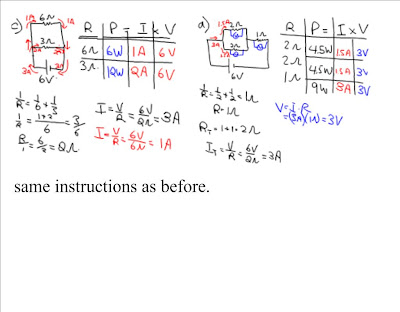
We also did that extra sheet but unfortunately I'm not able to post all that. But besides the point here is what I did, pretty sure its correct but might want to make sure monday. I took total current going into the parallel circuit thats part of a series circuit and times it by total resistance of that parallel circuit giving me voltage. Then took that voltage and divided it by each individual resistance to find current of each resistor. Anyhow thats all and I would like to ask to scribe again monday.
Final words: I R SRY :)


We also did that extra sheet but unfortunately I'm not able to post all that. But besides the point here is what I did, pretty sure its correct but might want to make sure monday. I took total current going into the parallel circuit thats part of a series circuit and times it by total resistance of that parallel circuit giving me voltage. Then took that voltage and divided it by each individual resistance to find current of each resistor. Anyhow thats all and I would like to ask to scribe again monday.
Final words: I R SRY :)
Friday, June 6, 2008
Thursday, June 5, 2008
THURSDAY JUNE 5, 2008 !
So today in class we did a few things .. THE END just kidding :)
The first thing we did was the last couple of pages for CHAPTER 35 ELECTTRIC CIRCUITS. I'm too shy to tell help you fill in the blanks, so let's move on. The next thing we did was go over SIMPLE CIRCUITS on the white boards. There's alot ot things going on, so if you need the answers ask anyone that was present =).
Here's a little bit of cheat sheet if you are ever doubtful of what belongs to which and who belongs to what and so on so forth.

The first thing we did was the last couple of pages for CHAPTER 35 ELECTTRIC CIRCUITS. I'm too shy to tell help you fill in the blanks, so let's move on. The next thing we did was go over SIMPLE CIRCUITS on the white boards. There's alot ot things going on, so if you need the answers ask anyone that was present =).
Here's a little bit of cheat sheet if you are ever doubtful of what belongs to which and who belongs to what and so on so forth.
We also got 2 sheets that deal with COMPOUND CIRCUITS. There are 5 steps to allow us to answer these problems, and they are stated on the first sheet.
PS - I'm not actually shy, I just think you can ask your fellow classmates for the fill-in-the-blanks =)
Wednesday, June 4, 2008
Wednesday, June 4
ANSWERS!!
Grade 12 Electric Circuits: Resistivity Problems
1) A = ρL/R
= (1.7 x 10⁻⁸)(20) / (0.10)
= 3.4 x 10⁻⁶ m2
A = πr2
r = √(A/π)
= √(3.4 x 10⁻⁶ / π) x 2
d = 2.1 x 10⁻³ m
2) L = RA/ρ
= (1.5)(2.5 x 10⁻⁷) / (100 x 10-8)
= 0.38 m
3) ρ = RA/L
= (0.04)(2.0 x 10⁻⁶ / (5.0)
= 1.6 x 10⁻⁸ Ωm
4) L = RA/ρ
= (3.0)(1.5 x 10⁻⁶) / (100 x 10-8)
= 4.5 m
5) A = ρL/R
= (5.5 x 10⁻⁸)(0.2) / (0.10)
= 1.1 x 10⁻⁷ m2
A = πr2
r = √(A/π)
= √(1.1 x 10⁻⁷ m2 / π) x 2
d = 3.7 x 10⁻⁴ m
Today we corrected Chapter 23: Study Guide Simple Circuits. We were handed Chapter 34: Electric Current (the “fun” thing) and corrected the first page. Lastly, we were given worksheets called Series and Parallel Circuits, and Simple Circuits.
Grade 12 Electric Circuits: Resistivity Problems
1) A = ρL/R
= (1.7 x 10⁻⁸)(20) / (0.10)
= 3.4 x 10⁻⁶ m2
A = πr2
r = √(A/π)
= √(3.4 x 10⁻⁶ / π) x 2
d = 2.1 x 10⁻³ m
2) L = RA/ρ
= (1.5)(2.5 x 10⁻⁷) / (100 x 10-8)
= 0.38 m
3) ρ = RA/L
= (0.04)(2.0 x 10⁻⁶ / (5.0)
= 1.6 x 10⁻⁸ Ωm
4) L = RA/ρ
= (3.0)(1.5 x 10⁻⁶) / (100 x 10-8)
= 4.5 m
5) A = ρL/R
= (5.5 x 10⁻⁸)(0.2) / (0.10)
= 1.1 x 10⁻⁷ m2
A = πr2
r = √(A/π)
= √(1.1 x 10⁻⁷ m2 / π) x 2
d = 3.7 x 10⁻⁴ m
Today we corrected Chapter 23: Study Guide Simple Circuits. We were handed Chapter 34: Electric Current (the “fun” thing) and corrected the first page. Lastly, we were given worksheets called Series and Parallel Circuits, and Simple Circuits.
Wednesday, May 28, 2008
Tuesday, May 27, 2008
Tuesday, May 27
Today we corrected the Moving Charges Worksheet. I'm feeling so generous so here's the answers:
4) a) Fe and Fg
b) Positive charge
c) Fe = Fg
mg = Eq
q = mg/E = (3.2 x 10⁻¹⁵)(9.8) / (19600)
= 1.6 x 10⁻¹⁸ C
5) B = F/IL
= (0.40) / (20.0)(0.15)
= 0.13 T
6) B = F/IL
= (6.0 x 10⁻⁵) / (1.5)(0.50)
= 8.0 x 10⁻⁵ T
7) F = BIL
= (5.5 x 10⁻⁵)(20.0)(10.0)
= 1.1 x 10⁻² N
8) B = F/qv
= (5.6 x 10⁻¹³) / (1.6 x 10⁻¹⁹)(2.1 x 10⁵)
= 16.7 T [left]
9) F = Bqv
= (1.2)(1.6 x 10⁻¹⁹)(8.6 x 10⁴)
= 1.65 x 10⁻¹⁴ N [right]
10) B = F/qv
= (4.0 x 10⁻⁶) / (1.6 x 10⁻¹⁹)(5.0 x 10⁵)
= 5.0 x 10⁷ T [into the page]
11) q = F/Bv
= (4.8 x 10⁻¹⁴) / (5.0 x 10⁻²)(2.0 x 10⁶)
= 4.8 x 10⁻¹⁹ C
12)
a) F = Bqv
= (0.080)(1.6 x 10⁻¹⁹)(4.0 x 10⁶)
= 5.12 x 10⁻¹⁴ N
b) R = mv2/F
= (9.11 x 10⁻³¹)(4.0 x 10⁶)2 / (5.12 x 10⁻¹⁴)
= 2.84 x 10⁻⁴ m
13) v = BqR/m
= (5.0 x 10⁻⁴)(1.6 x 10⁻¹⁹)(0.50) / (9.11 x 10⁻³¹)
= 4.4 x 10⁷ m/s
We also picked up a Review sheet and a worksheet named "The Path of a Charged Particle in a Magnetic Field." Test on Thursday !
4) a) Fe and Fg
b) Positive charge
c) Fe = Fg
mg = Eq
q = mg/E = (3.2 x 10⁻¹⁵)(9.8) / (19600)
= 1.6 x 10⁻¹⁸ C
5) B = F/IL
= (0.40) / (20.0)(0.15)
= 0.13 T
6) B = F/IL
= (6.0 x 10⁻⁵) / (1.5)(0.50)
= 8.0 x 10⁻⁵ T
7) F = BIL
= (5.5 x 10⁻⁵)(20.0)(10.0)
= 1.1 x 10⁻² N
8) B = F/qv
= (5.6 x 10⁻¹³) / (1.6 x 10⁻¹⁹)(2.1 x 10⁵)
= 16.7 T [left]
9) F = Bqv
= (1.2)(1.6 x 10⁻¹⁹)(8.6 x 10⁴)
= 1.65 x 10⁻¹⁴ N [right]
10) B = F/qv
= (4.0 x 10⁻⁶) / (1.6 x 10⁻¹⁹)(5.0 x 10⁵)
= 5.0 x 10⁷ T [into the page]
11) q = F/Bv
= (4.8 x 10⁻¹⁴) / (5.0 x 10⁻²)(2.0 x 10⁶)
= 4.8 x 10⁻¹⁹ C
12)
a) F = Bqv
= (0.080)(1.6 x 10⁻¹⁹)(4.0 x 10⁶)
= 5.12 x 10⁻¹⁴ N
b) R = mv2/F
= (9.11 x 10⁻³¹)(4.0 x 10⁶)2 / (5.12 x 10⁻¹⁴)
= 2.84 x 10⁻⁴ m
13) v = BqR/m
= (5.0 x 10⁻⁴)(1.6 x 10⁻¹⁹)(0.50) / (9.11 x 10⁻³¹)
= 4.4 x 10⁷ m/s
We also picked up a Review sheet and a worksheet named "The Path of a Charged Particle in a Magnetic Field." Test on Thursday !
Wednesday, May 21, 2008
Today we learned that in order for an object to move from one distance to another distance above the earth's surface, it needs a certain amount of force which increases its gravitational potential energy (work) to raise a mass from d1 to d2.
Electric potential energy is the same thing as when you place a positive charge between parallel plates. The charge is attracted to the negative plate but in order for the plate to move further away a force must be applied upward. Making a second height other than the first. The area of the shaded region between the two heights reps the increase in electric potential energy.
Calculating Electric potential energy.
PE(1)/(force*height1)=(Force)(distance of charge from negative plate)
=?J (amount of electric potential energy the charge has from the -ve plate)
Now you calculate the PE of charge at a second height
PE(2)=(Force)(second distance of charge from negative plate)
=?J(amount of electric potential energy the charge has from the -ve plate at a second distance)
Now to find the total PE b/w the two positions YOU SUBTRACT PE(1) from PE(2). Now the answer doesnt always have to be positive. Only if point B is further away from the negative plate. If point B is closer than it has a loss of PE.
This can be found from the shaded region of the two distances by multiplying the force of both(only if the same force is applied) by the two distances.
So PE is the work that is done in order to move a charge from one place to another.
ELECTRIC POTENTIAL
Electric potential and PE are very different. Electric potential is the potential energy that a charge has at a given point. Which can be found by this equation ( energy,J)/(charge,C)
The quantity is called a volt.
Potential Difference
To calculate the potential difference of a charge once it has moved to another point you must calculate the Electric potential of the first point V(1)=( energy,J)/(charge,C) and the same for the second point V(2)=( energy,J)/(charge,C). Doing the same thing as in Electric potential energy the Voltage of the first point from the voltage of the second point.
DeltaV=V(2)-V(1)
Now the amount of voltage that has changed in the positions of the charge is EQUAL to the amount of work needed to move the charge from one position to the next.
Now we were given a fun worksheet in which we went over in class and a second problem solving sheet which to be finished by tomorrow.
Electric potential energy is the same thing as when you place a positive charge between parallel plates. The charge is attracted to the negative plate but in order for the plate to move further away a force must be applied upward. Making a second height other than the first. The area of the shaded region between the two heights reps the increase in electric potential energy.
Calculating Electric potential energy.
PE(1)/(force*height1)=(Force)(distance of charge from negative plate)
=?J (amount of electric potential energy the charge has from the -ve plate)
Now you calculate the PE of charge at a second height
PE(2)=(Force)(second distance of charge from negative plate)
=?J(amount of electric potential energy the charge has from the -ve plate at a second distance)
Now to find the total PE b/w the two positions YOU SUBTRACT PE(1) from PE(2). Now the answer doesnt always have to be positive. Only if point B is further away from the negative plate. If point B is closer than it has a loss of PE.
This can be found from the shaded region of the two distances by multiplying the force of both(only if the same force is applied) by the two distances.
So PE is the work that is done in order to move a charge from one place to another.
ELECTRIC POTENTIAL
Electric potential and PE are very different. Electric potential is the potential energy that a charge has at a given point. Which can be found by this equation ( energy,J)/(charge,C)
The quantity is called a volt.
Potential Difference
To calculate the potential difference of a charge once it has moved to another point you must calculate the Electric potential of the first point V(1)=( energy,J)/(charge,C) and the same for the second point V(2)=( energy,J)/(charge,C). Doing the same thing as in Electric potential energy the Voltage of the first point from the voltage of the second point.
DeltaV=V(2)-V(1)
Now the amount of voltage that has changed in the positions of the charge is EQUAL to the amount of work needed to move the charge from one position to the next.
Now we were given a fun worksheet in which we went over in class and a second problem solving sheet which to be finished by tomorrow.
Friday, May 16, 2008
Thursday, May 15, 2008
Thursday, May 15, 2008
Today we read about Coulomb's Law in the green textbook and worked on a few practice questions. We also handed in several textbook questions for marks, using Coulomb's Law to calculate the force between two charges. This took up the majority of the period and the class packed up waaay too early today!
May 15, 2008
It seems to me that my fellow physics friends forgot to scribe again so I'll do a good deed and grab myself some BONUS marks. First, we started our new unit about electric and magnetic fields. We described the similarities and difference about Newtons gravitational law and coulombs law. Second, we had to read pages 415-418 on the green book. Also we were assigned to hand in some questions which is due for tomorrow.
Monday - May 12, 2008
So I'll also be doing the scribe for May 12.
On Monday, we went over the questions in the green textbook; 17, 20, 21, 22, and 23 on the board. It took a while and so afterwards, near the end of class, we watched a short video about space.
On Monday, we went over the questions in the green textbook; 17, 20, 21, 22, and 23 on the board. It took a while and so afterwards, near the end of class, we watched a short video about space.
Friday - May 9, 2008
So on this day we also went over some worksheets and were assigned the questions 17, 20, 21, 22, and 23 in the green textbook on page 172. We also got to see one presentation today from Ethan which was about Mars Exploration. Good job by the way Ethan.
Thursday - May 8, 2008
So I know this was a week ago but no one has scribed for this date so I thought I would do it. Since it was almost a week ago I don't remember much so this scribe will be pretty short.
All right, so on May 8 we watched a film and had to make 5 points about it which we handed in afterwards. We also corrected some sheets and that was it.
All right, so on May 8 we watched a film and had to make 5 points about it which we handed in afterwards. We also corrected some sheets and that was it.
Subscribe to:
Posts (Atom)
